
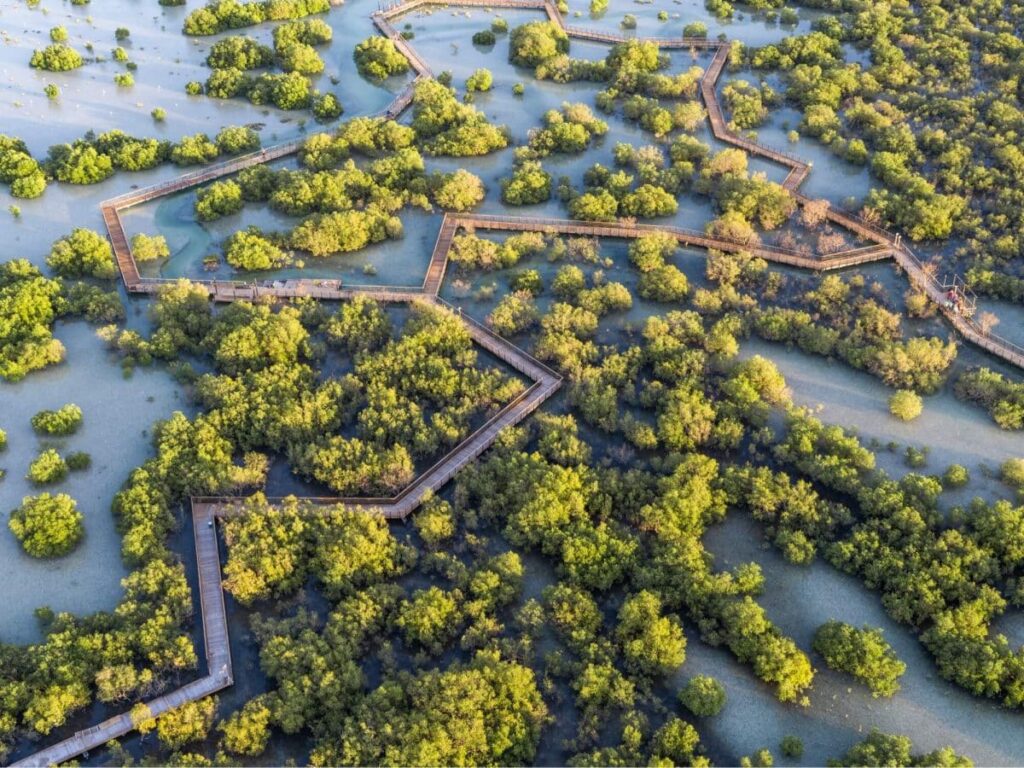
Nabat Uses AI and Drones to Cut Mangrove Restoration Costs
Nabat, an Abu Dhabi-based environmental technology company, is deploying artificial intelligence (AI) and autonomous drones to reduce mangrove restoration costs by three to five times compared with conventional approaches, while expanding the scale of environmental monitoring and restoration activities.
Working alongside the Environment Agency – Abu Dhabi (EAD), the company uses high-resolution drone imagery to survey approximately 800 hectares of land daily with a single team. Its autonomous drones can also distribute mangrove seeds across 50 to 60 hectares per day.
This capacity allows a single team to monitor an area equivalent to more than 1,100 football pitches in one day, while autonomous drones can disperse seeds across an area comparable to 70 to 84 football pitches daily.
Mehdi Ajana, Vice President of Strategy at Nabat, said the technology addresses longstanding challenges in environmental restoration, particularly the identification of suitable planting locations and the assessment of restoration outcomes.
“We have sophisticated systems to manage our cities, infrastructure and businesses, but very limited tools to understand and manage nature,” Ajana said.
“Take mangroves. We know they protect coastlines, support biodiversity and store carbon. Yet we struggle to answer basic questions: Where are they? How healthy are they? Where should we intervene? Is restoration actually working?”
Nabat began developing solutions to these challenges three years ago through its collaboration with EAD, integrating drone imagery, satellite data and AI-powered models to evaluate environmental conditions.
Ajana explained that conventional field surveys typically involve collecting samples from limited locations and using the findings to estimate conditions across larger areas. AI-based systems, however, enable teams to examine entire restoration sites in greater detail, improving the assessment of environmental conditions and helping identify areas requiring intervention.