

CBUAE Reviews UAE Banking Sector Performance and Resilience
The Central Bank of the UAE (CBUAE) has reviewed the performance and resilience of the country’s banking sector, with banking assets, loans and deposits all recording year-on-year growth through the end of August 2026. The review took place during a meeting convened by CBUAE Governor Khaled Mohamed Balama with CEOs of banks operating in the UAE.
The meeting, attended by assistant governors and senior CBUAE officials, reaffirmed the central bank’s focus on working with the banking sector to safeguard financial stability and monitor developments across the UAE’s financial system.
According to CBUAE indicators, banking assets increased by 12.9% year-on-year as of the end of August 2026, compared with the same period in 2025. Total bank loans increased by 18.8%, while bank deposits grew by 13.0%, reflecting continued expansion in credit and funding across the sector.
UAE banking sector records stronger asset quality
The latest figures also showed continued improvement in banking sector asset quality. The non-performing loans (NPL) ratio declined to 2.6%, while the net NPL ratio improved to 1.2%.
The CBUAE said the developments reflected the effectiveness of banks’ risk management and credit policies, as well as the central bank’s supervisory and prudential frameworks. Financial stability remains a core responsibility of the CBUAE, which monitors risks and vulnerabilities across the UAE financial system and develops measures to strengthen resilience.
The participants also reviewed the implementation of the Financial Institutions Resilience Package (FIRP), launched by the CBUAE in March 2026. The package was designed to support continued business activity while strengthening the resilience of the national economy. The central bank has described the initiative as a proactive framework supporting financial institutions and the wider economy.
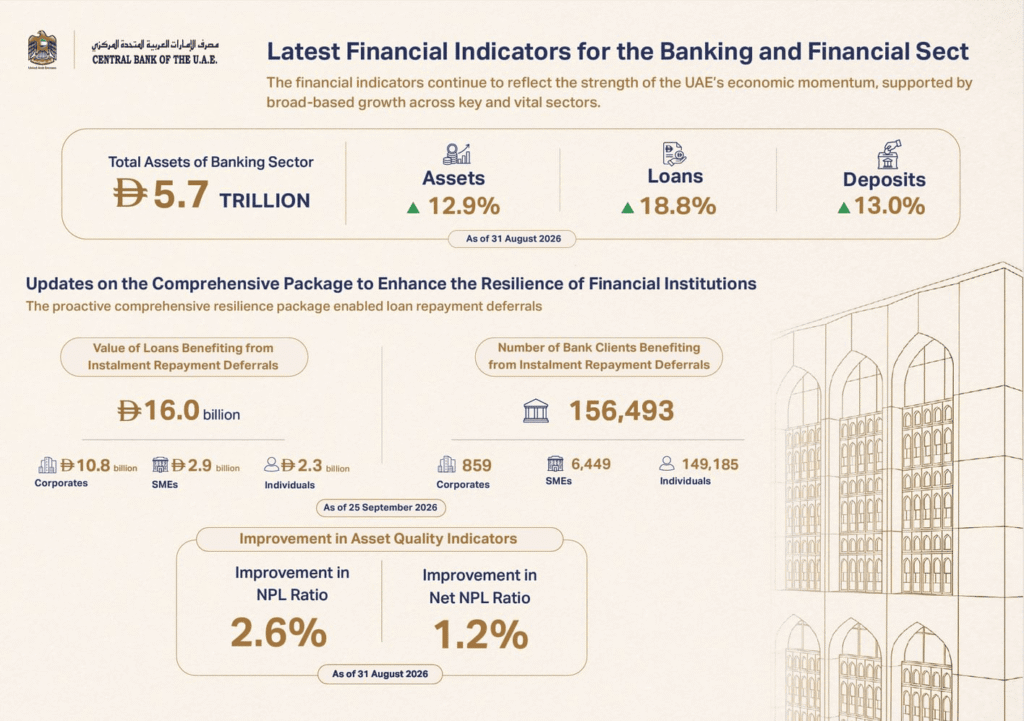
By the end of August, measures under the package had provided payment deferrals and waived commissions and fees on loans totalling AED 15.9 billion. A total of 155,971 banking customers benefited, including individuals, small and medium-sized enterprises (SMEs) and large corporations.
Approximately 849 private-sector companies received support totalling AED 10.7 billion, while 6,441 SMEs benefited from loan repayment deferrals totalling AED 2.9 billion. The package also supported approximately 148,681 individual banking customers through loan repayment deferrals totalling AED 2.3 billion.
CBUAE calls for continued digital transformation
Khaled Mohamed Balama said the banking sector’s performance indicators reflected the strength and resilience of the UAE financial system and the effectiveness of its supervisory and prudential frameworks.
He emphasised the importance of continued innovation and digital transformation across the banking sector, alongside stronger consumer protection and financial inclusion. Banks were also encouraged to maintain high standards of governance, risk management and compliance.
The meeting further highlighted the role of UAE banks in supporting economic and commercial activity as the sector expands its lending and deposit base. CBUAE data has continued to show substantial growth in the banking system, with the central bank maintaining regular monitoring of assets, credit, deposits, and financial soundness indicators.
Balama also thanked bank chairmen and CEOs for their contribution to the UAE’s economic agenda, describing them as key partners in strengthening the country’s position as a global financial centre.
The latest review comes as the CBUAE continues to balance banking sector growth with financial stability, resilience, digital transformation and prudential oversight. The August figures provide the latest snapshot of a UAE banking system that continues to expand while recording improvements in asset quality.