
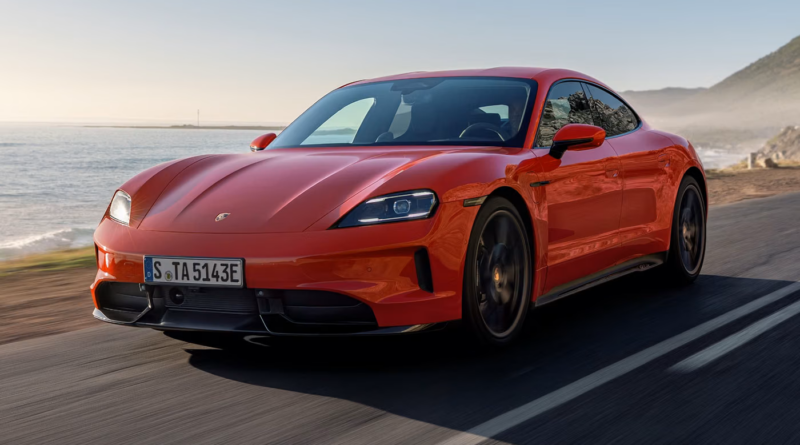
Porsche Taycan Future Unclear as EV Sales Decline and Strategy Shifts
Porsche has pushed back against reports that its flagship electric vehicle could be phased out before the end of the decade, as the automaker reassesses its approach to electric vehicle production.
Porsche CEO Michael Leiters clarified the company’s position following reports that the automaker and its works council had agreed to phase out the Taycan by the end of the decade.
However, Leiters said Porsche’s efforts to simplify production should not be interpreted as a decision to end the model line.
The clarification comes as the Porsche Taycan faces significantly weaker sales compared with its peak performance. Therefore, the model’s future has become an important part of Porsche’s broader strategy as demand for luxury electric vehicles changes across major markets.
Porsche Taycan sales decline
Taycan deliveries have fallen considerably over the past two years.
Porsche delivered 40,629 Taycan units globally in 2023. However, annual deliveries dropped to 16,339 units in 2025.
The decline has continued into 2026. Porsche shipped 6,219 Taycan vehicles during the first half of the year, according to the figures cited in the reports surrounding the model’s future.
As a result, Porsche is reducing the number of Taycan variants available as it seeks to simplify production and reduce manufacturing complexity.
The strategy reflects a broader challenge facing premium electric vehicles. Moreover, competition has intensified as Chinese automakers introduce electric models that combine high performance with lower pricing.
Meanwhile, changing consumer demand and higher import tariffs in the United States have added further pressure to the global electric vehicle market.
For Porsche, the situation creates a difficult balance between maintaining its investment in electrification and responding to changing customer demand.
Porsche rethinks its EV strategy
The uncertainty surrounding the Taycan forms part of a broader recalibration of Porsche’s electrification strategy.
The company has already adjusted some of its earlier plans for an electric-only future. Furthermore, upcoming versions of the 718 Cayman and Boxster are expected to retain combustion-engine options rather than moving exclusively to electric power.
This approach gives Porsche greater flexibility as it evaluates demand across different vehicle segments.
The company could also eventually consider an electric Panamera as part of its future product strategy. However, industry speculation suggests that Porsche may determine that developing an electric Panamera makes greater financial sense than creating a completely new second-generation electric successor to the Taycan.
For now, Porsche has not confirmed plans to discontinue the Taycan.
Instead, the model’s immediate future appears to be linked to the company’s efforts to reduce production complexity while adapting its electric vehicle portfolio to changing market conditions.
The Taycan therefore remains an important indicator of how Porsche balances its electric ambitions with customer demand, profitability and the continued role of combustion-powered models.