
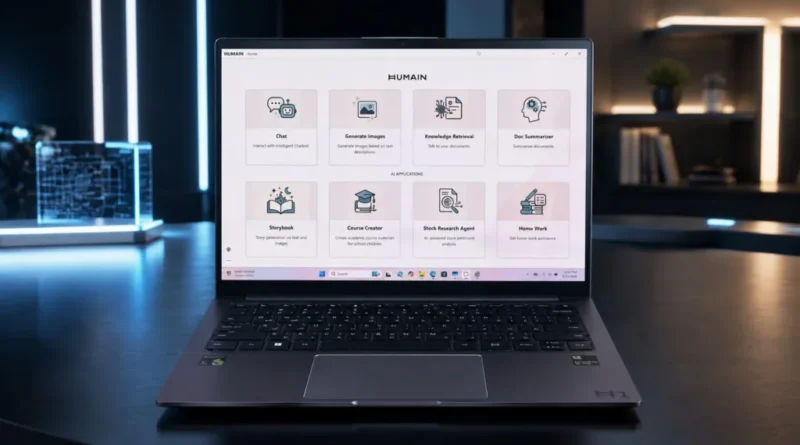
HUMAIN Unveils AI Laptop With On-Device Processing in Saudi Arabia
Saudi Arabia’s HUMAIN has introduced a new artificial intelligence laptop designed to run advanced AI workloads directly on the device, reducing reliance on cloud-based processing.
The PIF-owned technology company developed the next-generation AI PC over the past 12 months in collaboration with Qualcomm. The project combines dedicated computing hardware with agent-based artificial intelligence to create a different approach to personal computing.
The laptop integrates a central processing unit, graphics processing unit, and neural processing unit. As a result, it can process AI workloads locally while potentially reducing dependence on external cloud infrastructure.
The device also moves beyond conventional app-based computing. Instead of requiring users to open and manage multiple applications, its intent-driven approach lets users describe an objective while AI agents coordinate the tasks needed to complete it.
HUMAIN targets a new model of personal computing
HUMAIN has not yet disclosed the laptop’s complete specifications, pricing, release date, or manufacturing details. However, the company is expected to provide additional information during the LEAP technology conference in Riyadh, scheduled for August 31 to September 3.
Meanwhile, technology reports have identified the showcased computer as the potential Horizon Ultra, which could become the most advanced model in HUMAIN’s planned laptop portfolio.
The broader range is expected to include the student-focused Horizon S and the enterprise-oriented Horizon Pro. However, HUMAIN has yet to confirm the final specifications or commercial positioning of the new device.
Reports have also linked the Horizon Ultra to Qualcomm’s Snapdragon X2 platform and permanent 5G connectivity. These specifications, however, have not been officially confirmed for the laptop unveiled by HUMAIN.
The company previously introduced the Horizon Pro in September 2025. That device used Qualcomm’s Snapdragon X Elite processor and offered more than 18 hours of claimed battery life.
It also introduced HUMAIN ONE, an AI-focused interface running on Windows on Arm. In addition, the system incorporated ALLaM, HUMAIN’s Arabic-first large language model.
Running AI models directly on a computer could provide several advantages. Local processing can reduce response times and improve functionality when internet connectivity is limited. Moreover, organisations could gain greater control over sensitive information by keeping certain AI workloads on-device rather than sending them to external cloud systems.
HUMAIN builds a wider AI ecosystem
The technology could have particular relevance for governments, financial institutions, and businesses that handle sensitive information.
Local AI processing can potentially support stronger data-control requirements while reducing reliance on external infrastructure. However, the practical benefits will depend on the device’s processing capabilities, software architecture, and the number of AI tasks that can operate locally.
HUMAIN’s broader strategy extends well beyond consumer computers. Launched by Saudi Arabia’s Public Investment Fund in 2025, the company is developing an AI ecosystem spanning models, cloud services, data centers, and computing infrastructure.
The company has also announced partnerships with major technology providers, including Qualcomm, Nvidia, and AMD. These relationships form part of Saudi Arabia’s wider effort to develop domestic AI capabilities and strengthen its technology infrastructure.
HUMAIN and Qualcomm are also establishing an AI engineering center in Riyadh. Furthermore, the companies plan to deploy large-scale Qualcomm-powered data-center capacity beginning in 2026.
Therefore, the new laptop represents more than a standalone hardware product. It forms part of a broader strategy connecting personal computing with AI models, infrastructure, data centers, and enterprise applications.
Its commercial prospects, however, will depend on pricing, software compatibility, performance, and the effectiveness of its intent-driven computing system in everyday use. HUMAIN will also face competition from established PC manufacturers and technology platforms as the market for AI-enabled personal computers continues to develop.