
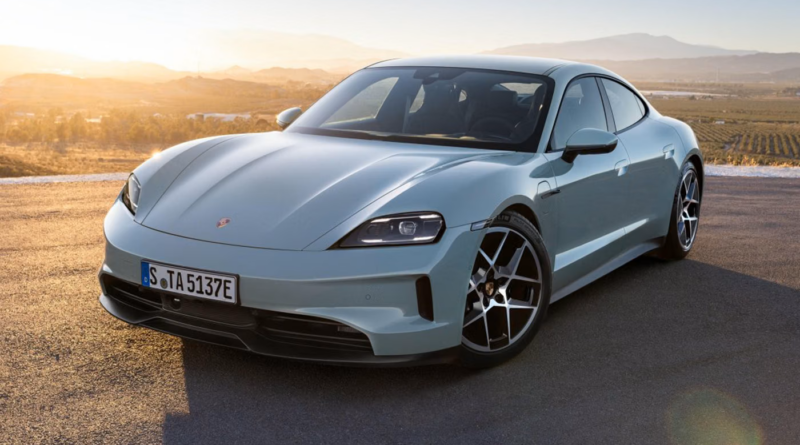
Porsche Taycan Production Move to Leipzig Reportedly Scrapped
Porsche could be preparing to end production of the Taycan, its first series-production battery-electric model, by the end of the decade. A report from German business publication WirtschaftsWoche claims the automaker has reached an agreement in principle with its works council to phase out the electric sedan, although the reported plan has not been formally finalised.
The potential decision would mark a significant change in Porsche’s electrification strategy. The Taycan helped establish Porsche as a serious player in high-performance electric vehicles, yet weaker sales, changing consumer preferences and pressure on the company’s finances are reportedly forcing a reassessment of its product portfolio.
Taycan Sales Decline as Porsche Reassesses Its EV Strategy
The reported production decision follows a sharp deterioration in Porsche’s financial performance. The company’s operating profit reportedly fell from €5.64 billion to €413 million over the past year, adding pressure to its broader product and investment strategy.
Taycan deliveries have also declined considerably. Porsche sold 11,510 Taycans in 2025, down from 21,302 units the previous year, representing a substantial year-on-year reduction.
Meanwhile, the arrival of the Macan EV has given Porsche customers another battery-electric option. The electric SUV also occupies a vehicle category that has become particularly important within the luxury market, potentially making it a stronger commercial proposition than a low-slung electric sports sedan.
Consequently, Porsche is reportedly reconsidering plans to move Taycan production from its dedicated manufacturing line in Zuffenhausen to Leipzig. Instead, management and the Porsche works council are said to have agreed in principle to end the model line by 2030.
The reported plan remains unfinalised, so Porsche’s future production schedule could still change. However, the potential cancellation would indicate a broader effort to simplify the company’s model range and allocate resources toward products with stronger commercial prospects.
Porsche’s Electric Future Takes a Different Direction
The reported Taycan phase-out would be particularly notable because Porsche recently continued investing in the model. The upcoming 2027 Taycan has been developed with features intended to appeal to traditional performance-car enthusiasts, including simulated manual gear shifts.
Porsche CEO Michael Leiters has also recently indicated that there were no immediate plans to discontinue the model. Therefore, a production end date of 2030 would represent a longer-term strategic decision rather than an immediate withdrawal from the market.
The company is also recalibrating its electrification plans. Instead of pursuing an exclusively battery-electric product strategy, Porsche is reportedly placing greater emphasis on a combination of combustion engines, hybrids and electric vehicles.
That approach reflects the complexity of the premium automotive market. While electric vehicles remain an important part of Porsche’s future, the company must balance emissions requirements and technology investment with customer demand, manufacturing costs and profitability.
The Taycan’s position within the lineup makes that calculation particularly important. As a performance-oriented sedan, it occupies a more specialised segment than Porsche’s SUVs, while the company’s combustion and hybrid models continue to provide a broader connection to its traditional customer base.
Taycan’s Legacy Could Outlast Its Production Run
The Taycan’s potential retirement would carry significance beyond Porsche’s sales figures. When it launched, the model challenged the assumption that an electric car could not deliver the acceleration, handling, and driving character expected of a Porsche.
Its combination of rapid performance, low-mounted battery architecture and high-speed capability helped establish the modern luxury performance EV category. It also demonstrated that electrification could extend beyond efficiency-focused vehicles into the territory traditionally occupied by sports cars.
However, market recognition alone does not guarantee long-term production. If the reported plans materialise, Porsche would be acknowledging that the commercial conditions surrounding premium electric sedans have changed since the Taycan’s introduction.
For Porsche, the next phase appears increasingly focused on flexibility rather than a single powertrain direction. For the Taycan, meanwhile, a potential end to production by 2030 would close the first chapter of Porsche’s modern electric era, but its influence on the performance EV market is likely to remain long after the final car leaves the factory.